Saturday, January 10, 2015

There are good times for you if you have these skills!

Statistical Analysis and Data Mining? Middleware and Integration Software? There are good times for you if you have these skills!


 "Statistical analysis and data mining" topped LinkedIn's list of the 25 Hottest Skills That Got People Hired in 2014,  moving up from number 5 in 2013.

"We live in an increasingly data driven world, and businesses are aggressively hiring experts in data storage, retrieval, and analysis. Across the globe, statistics and data analysis skills were highly valued"  Sohan Murthy, research consultant at LinkedIn, wrote in a blog post.

Glassdoor reports a median salary of $118,709 for a data scientist and  $64,537 for a programmer.

If you have any involvement in data analytics and want to develop your career, is worth learning some of the most commonly used tools:

- SQL/RDB;
- R and Python;
- Excel;
- SAS and SPSS;
-Hadoop.

There are lots of roles that involve working with analytics and big data, but some of the most common titles are:

- Data Analyst - Common skills that you will be asked for include SQL, R, SAS and Excel, and often Hadoop.
- Data Scientist - As well as the analytics skills that an analyst will be expected to have, data scientists will be expected to have programming skills (Java or Python).

In 2014, for the second year, O'Reilly Media conducted an anonymous survey to expose the tools successful data analysts and engineers use, and how those tool choices might relate to their salary.

By a considerable margin, the most broadly-used software was SQL , which was selected by 71% of respondents.

R and Python were the next most widely-used tools — they were selected by 43% and 41% of survey-takers, respectively.

"R and Python are likely popular because they are easily accessible and effective open source tools for analysis",the authors of the report note.

Moreover, statistics has been working on collecting and analyzing data even before computers existed. Whatever technological revolutions that may occur, statistics will remain relevant because if we can measure something, we improve it.

Related skills were also ranked highly:
6. Business Intelligence
10. Perl/Python/Ruby
11. Data Engineering and Data Warehousing

The rest of the LinkedIn's list was populated by tech skills.

Hottest Skills of 2014 on LinkedIn:
1. Statistical analysis and data mining
2. Middleware and integration software
3. Storage systems and management
4. Network and information security
5. SEO/SEM Marketing
6. Business intelligence
7. Mobile development
8. Web architecture and development framework
9. Algorithm design
10. Perl/Python/Ruby

Last year, the top 2013 LinkedIn skill was Social Media Marketing, with Statistical Analysis and Data Mining ranked at 5.


Thursday, January 8, 2015

JavaScript is not an “ugly duckling” anymore!

I always find it fascinating to read about trends in the use of programming languages.

Based on a formula assessing Internet searches on languages, the Tiobe Index named JavaScript its Language of the Year for 2014. 


 “After all these years, JavaScript has finally become TIOBE's language of the year. It was a close finish. Swift and R appeared to be the main candidates for the title but due to a deep fall of Objective-C this month, a lot of other languages took advantage of this and surpassed these two candidates at the last moment.”  Tiobe said.

TIOBE programming index is “a measure of popularity of programming languages, calculated from number of search engine results for queries containing the name of the language” (TIOBE Programming Community Index Definition"). TIOBE takes into account only Turing complete languages, so some popular languages like HTML or SQL are not present in ranking.
JavaScript has won the award because it had an increase of roughly 1.70 percent of share. "The JavaScript programming language has a long history and is always considered as the 'ugly duckling' from a language design point of view. Nevertheless, JavaScript has become the standard browser language through the years," Tiobe said.


So, is JavaScript the Language of the Future?


Despite being on the 10th ranked programming language in the latest Tiobe Index, JavaScript is the dominant programming language choice for startups (see the growing use of JavaScript on GitHub in recent years – now is the top language.
JavaScript is one of the preferred ways of developing applications for Windows 8's new UI.
They say being able to use the same language on the front end and the back end makes life easier for development teams.

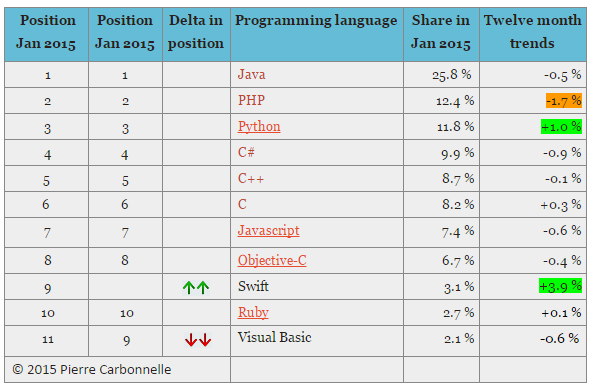
The PyPL (Popularity of Programming Language) index, which analyzes Google searches on language tutorials (the more a specific language tutorial is searched, the more popular the language is assumed to be), named Swift its Language of the Year for 2014.
Swift had a rating of 3 percent for 2014 and ranked ninth on PyPL's index for the month, jumping past two long-established languages: Ruby and Visual Basic.
In the January PyPL index, Java was tops, with a 25.8 percent share, followed by PHP (12.4 percent), Python (11.8 percent), C# (9.9 percent), and C++ (8.7 percent).
Top 10 were C (8.2 percent), JavaScript (7.4 percent), Objective-C (6.7 percent), Swift (3.1 percent), Ruby (2.7 percent), and Visual Basic (2.1 percent).
Source: https://sites.google.com/site/pydatalog/pypl/PyPL-PopularitY-of-Programming-Language


Sunday, April 6, 2014

Best Google Fonts For Flat Design

Why Google Web Fonts?


It provides high-quality web fonts that you can include in your pages using the Google Web Fonts API and has three advantages that make it ideal for many freelancers and small businesses: It’s open source and free, it requires no sign-up, and the deployment of fonts is fast.

Flat design focuses on typography, colors, simple shapes to emphasize clarity and usability. Because it often employs bright color schemes, weights and clean lines are important when it comes to lettering.

Here is the list of typefaces that are fit with Flat design most:

1. Droid Sans

Droid is a font family first released in 2007 and created by Ascender Corporation. The fonts are intended for use on the small screens of mobile handsets and were designed by Steve Matteson.

Droid Sans is a sans serif typeface with open forms and a neutral, yet friendly appearance and was optimized for user interfaces. 

droid sans

2. Oxygen 

The basic concept for Oxygen Font was to design a clear, legible, sans serif, that would be rendered with Freetype on Linux-based devices.

Oxygen is a Unicode typeface family that supports languages that use the Latin script and its variants.. 


3. Roboto 

Roboto is also a sans-serif typeface family. Google describes the font as "modern, yet approachable", with "a dual nature". The family includes regular and oblique styles of Thin, Light, Regular, Medium, Bold, Black, and Condensed widths.

4. Open Sans

Open Sans is a clean and modern sans-serif typeface, designed by Steve Matteson.

Since its release in 2010, Open Sans quickly became the preferred typeface by many designers, as it was a fantastic substitute for Helvetica. According to Google, it was developed with an "upright stress, open forms and a neutral, yet friendly appearance" and is "optimized for legibility across print, web, and mobile interfaces."

Its design is almost identical to that of Droid Sans, with the exception of wider characters and the inclusion of italic variants. 


Open Sans is available in a large number of variants. There are 5 variants for weight (300 Light, 400 Normal, Semi-Bold 600, Bold 700 and Extra Bold 800) and each one has an italic version.

5. Lato

“Lato,” meaning “Summer” in Polish, is a sans serif typeface family, developed in summer 2010 and released in December 2010 under SIL Open Font License, with five weights: 100, 300, 400, 700, 900 and corresponding italics.

The semi-rounded letters give Lato a strong yet friendly tone, allowing for flexibility of use in either body text or headlines. “Male and female, serious but friendly” says Łukasz Dziedzic, the designer of Lato.


In 2013 – 2014, the family was greatly extended. The Lato 2.0 family now supports 100+ Latin-​​based languages, 50+ Cyrillic-​​based languages as well as Greek and IPA phonetics.

6. Source Sans Pro

Source Sans Pro, Adobe's first open source typeface family, was designed by Paul D. Hunt. It is a sans serif typeface intended to work well in user interfaces.

Source Sans Pro is a sans serif font designed with a generous width. It is currently available in six weights, from ExtraLight to Black, in upright and italic styles. The typeface has wide language support for Latin script.

7. Raleway

Raleway is an elegant sans-serif typeface, designed by Matt McInerney in a single thin weight.

8. Montserrat 

Montserrat font is sans serif font which is designed by Julieta Ulanovsky. Montserrat font family has 2 weights.
9. Quicksand

This is a display sans serif.

10. PT Sans

PT Sans is based on Russian sans serif types of the second part of the 20th century, but at the same time has distinctive features of contemporary humanistic designs. The family consists of 8 styles: 4 basic styles, 2 captions styles for small sizes, and 2 narrows styles for economic type setting.

11. Libre Baskerville

Libre Baskerville is a web font optimized for body text.

12. Quattrocento Sans

Quattrocento Sans is a Classic, Elegant and Sober typeface.

13. Josefin Slab

Josefin Slab is one of the thinnest slab fonts and have an elegant, upscale look and feel.
14. Philosopher

This font is universal: It can be used in logos, headlines, and for text.

Monday, February 10, 2014

Parallax Scrolling Effect with css and jquery, because i love simplicity.


“There is no greatness where there is not simplicity" - Lev Tolstoy


I made this Parallax Scrolling Effect for my blog in a few minutes, just with css and jquery.

Parallax scrolling is a technique, where, as you scroll, the background sections translate slower than the content in the foreground, creating the illusion of 3D depth.

This is my content div:

<div class='content' data-speed='1' data-type='background' style="background:url('http://para.png') 0 0 repeat-y; position:relative;">
</div>

I am using the a div with the attributes data-type & data-speed, which were introduced in HTML5. Since all I need to do is control the speed of the background images, I use data-type="background" and data-speed="1" as key attributes to specify the necessary parameters. For my post I use data-speed="10"

And this is the jQuery:


$(document).ready(function(){
$window = $(window);
    $('div[data-type="background"]').each(function(){
        var $bgr = $(this);
        $(window).scroll(function() {
            var yPos = -($window.scrollTop() / $bgr.data('speed'));
            var coord = '0%'+ yPos + 'px';
          $bgr.css({backgroundPosition:coord});
        });
    });
});

Wednesday, January 15, 2014

Radiant Orchid: innovation, creativity and originality


When it comes to web design, color is an important detail that can make or break your whole design.

Since 2000, the Pantone Color Institute™ has been designating a Color of the Year. The PANTONE Color of the Year is a reflection of what people are looking for.

The color for 2014? The magical Radiant Orchid that symbolize innovation, creativity and originality.

“While the 2013 color of the year, PANTONE 17-5641 Emerald, served as a symbol of growth, renewal and prosperity, Radiant Orchid reaches across the color wheel to intrigue the eye and spark the imagination,” said Leatrice Eiseman, executive director of the Pantone Color Institute®.

"An invitation to innovation, modern and versatile Radiant Orchid encourages creativity and originality. Imbued with a harmony of fuchsia, purple and pink undertones, Radiant Orchid inspires confidence and its rosy undertones emanate great joy, love and health."


TOP